Procedure & Regularity for Accuracy, True Dispute Resolution and Happiness

"Journal of Comparative Civil Procedure"

The Journal of Comparative Civil Procedure, in line with the objectives of the "Research Center for Justice and Civil Procedure at the University of Tehran", serves as a platform for showcasing the research, scholarly works, and scientific achievements of the Center. It collaborates with eminent Iranian and international professors of civil and commercial procedure to publish specialized articles by authors and researchers after rigorous peer review.

This trilingual journal (Persian-English-French) adopts a comparative approach to civil procedure, aiming to develop innovative solutions and refined methodologies for effective dispute resolution.

Scope and Focus

The journal prioritizes comparative research on themes such as:

    • Foundations of litigation and defense;

    • Judicial and quasi-judicial authorities (including administrative tribunals);

    • Jurisdiction and conflict resolution among diverse judicial/quasi-judicial bodies;

    • Procedural law and its governing principles;

    • Evidence and modern methods of proof;

    • Judgments, appeals, and remedies;

    • Res judicata and the effects of rulings;

    • Enforcement procedures and efficient execution of judgments;

    • Alternative dispute resolution (ADR) and consensual settlement mechanisms or Arbitration.

It also explores the interplay between justice and procedural law, bridging short-term (parties) and long-term (social) goals of adjudication—emphasizing social harmony, procedural fairness, and the principles of equitable justice.

Mission

The journal seeks to advance civil and commercial procedural law in Iran through comparative legal studies, critical analysis of methodologies, and their principled application.


  • COPE (Commitee on Publication Ethics)


Commercial International Arbitration

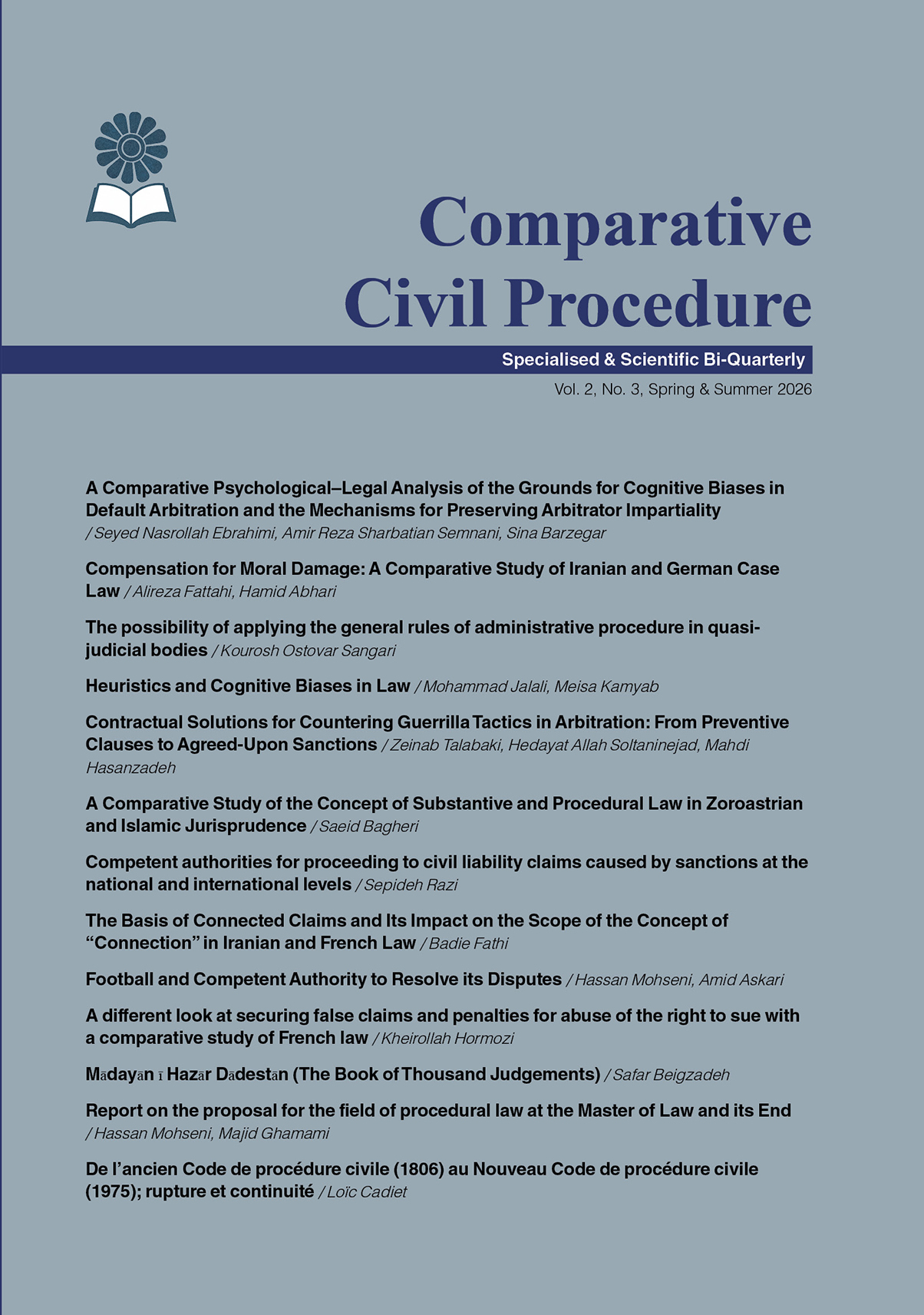
A Comparative Psychological–Legal Analysis of the Grounds for Cognitive Biases in Default Arbitration and the Mechanisms for Preserving Arbitrator Impartiality

Pages 6-28

Seyed Nasrollah Ebrahimi, Amir Reza Sharbatian Semnani, Sina Barzegar

Abstract Default arbitration, due to the non-appearance of the respondent and the absence of their defenses, constitutes a context susceptible to cognitive biases affecting arbitrators. This vulnerability exists across all types of arbitration, including commercial and domestic and international investment arbitration, potentially compromising the arbitrator’s impartiality. The present study aims to identify the circumstances in which cognitive biases emerge in default arbitration and to propose effective legal mechanisms to safeguard arbitrator impartiality. Employing a qualitative, analytical-comparative methodology, the research integrates principles of cognitive psychology—specifically the “fast and slow thinking” theory—and arbitration law, based on library-based analysis. Ten distinct cognitive biases were identified, each capable of influencing both procedural and substantive rulings in the absence of the respondent. The redesign of procedural requirements, engagement of independent experts, and establishment of multi-member arbitral tribunals, as opposed to sole arbitrators, can mitigate these biases and reinforce arbitrator impartiality. Properly structured procedural safeguards not only control cognitive biases but also enhance the legitimacy and enforceability of arbitral awards.


Keywords: default arbitration, arbitral award, cognitive bias, confirmation bias, effective notification

Civil Procedure

Compensation for Moral Damage: A Comparative Study of Iranian and German Case Law

Pages 29-54

hamid abhari, alireza fattahi

Abstract How can the intangible suffering of human beings be measured on the material scale of law? This problem of immeasurability constitutes one of the most profound ambiguities in the law of civil liability and has cast doubt upon the very acceptance of the principle of compensation for non-pecuniary damage. Employing a descriptive-analytical method and a comparative approach, the present study examines the manner in which the legal systems of Iran and Germany confront this ambiguity, with particular emphasis on judicial approaches and court decisions concerning methods of redressing such harm. The findings demonstrate that Iranian law, by drawing upon the dynamic capacities of Islamic jurisprudence and legislative provisions, is conducive to a development-oriented approach; nevertheless, its judicial practice remains uncertain and inconsistent in transitioning from traditional conservatism toward the recognition of effective forms of compensation. In contrast, the German legal system, relying on Article 253 of the Civil Code, has adopted a text-oriented and restrictive approach to contain such uncertainty, establishing non-compensation as the general rule except in limited statutory exceptions. The comparative analysis reveals that although both legal systems ultimately seek to safeguard human dignity, their responses to this ambiguity diverge.

Administrative Procedure

The possibility of applying the general rules of administrative procedure in quasi-judicial bodies

Pages 55-77

kourosh ostovar sangari

Abstract Abstract

Administrative law lacks a general code of administrative procedure, and quasi-judicial authorities do not have detailed or adequate procedural procedures except in limited cases. Therefore, the issue discussed in this article is whether it is possible to deduce general rules of administrative procedure from the existing procedural regulations in Iran and make them governing proceedings in quasi-judicial authorities. After examining some general rules of administrative procedure in some countries and also examining the general rules of criminal and civil procedural laws, the author has concluded that there are principles and rules in the Iranian procedural law system that are mandatory for quasi-judicial authorities to observe. These rules can be deduced from the general rules of civil procedural law and criminal procedural law, or can be considered as a legal and rational principle and, in general, as general rules of administrative procedure governing proceedings in quasi-judicial authorities.

Keywords: procedural law, administrative, principles, general rules, quasi-judicial authorities

Public Law & Civil Procedure

Law and Emotion: Intuitive Judging, Heuristics and Cognitive Biases in Law

Pages 79-103

Mohammad Djalali, Meisa Kamyab

Abstract Humans use heuristics unconsciously, i.e., cognitive processes or experience-based strategies that are used to solve a problem or reach a decision, leading to cognitive biases. Judges are human and prone to the same cognitive biases, especially since the nature of their job requires judgment under uncertainty. Heuristics and cognitive biases are unconscious and occur automatically.

This article uses data from behavioral science studies and desk research to address the question of which heuristics are used in the judicial process, what biases they lead to, and how they can be moderated. Confirmation bias, hindsight bias, availability bias, representation bias, and moral bias are among the most prominent ones. There are ways to minimize harmful biases in judgment. Training and publication of judicial opinions, utilizing checklists, reassessment (by judges themselves or a higher court), and writing judicial opinions are existing solutions, some of which are reflected in procedural law and should be taken seriously. It should also bear in mind that the fallibility of the mind requires a review of the irreversible legal consequences in the judicial justice system.

Commercial International Arbitration

Contractual Solutions for Countering Guerrilla Tactics in Arbitration: From Preventive Clauses to Agreed-Upon Sanctions

Pages 105-126

zeinab talabaki, Hedayat Allah Soltaninejad, Mahdi Hasanzadeh

Abstract The arbitration agreement, as the cornerstone of dispute resolution, is commonly viewed merely as an instrument for referring a dispute to arbitration. However, this minimalist approach overlooks its crucial potential to combat the destructive phenomenon of “guerrilla tactics”—a set of vexatious and dilatory actions aimed at protracting and undermining the proceedings, thereby eroding the fundamental advantages of arbitration: speed and efficiency. Therefore, this article aims to present a preventive contractual framework for disarming the “arbitration guerrilla” and addresses the key question: how can the arbitration agreement, through intelligent engineering, be transformed into an effective shield against this procedural scourge? Using a descriptive-analytical method, this study demonstrates that the key to an effective response lies not in ex post facto remedies, but in the activation of the principle of party autonomy. The findings indicate that by designing a structured and disciplined process (such as establishing codes of conduct and setting firm deadlines), stipulating effective financial sanctions (like cost allocation based on misconduct and the use of procedural penalty clauses), and incorporating powerful enforcement tools (suchas asymmetric clausesand requests for adverse inferences), parties can transform thearbitration agreement into a robust fortress against deliberate disruptions, thereby ensuring the integrity and efficiency of arbitration.

Shariat & Islamic Law and Civil Procedure

A Comparative Study of the Concept of Substantive and Procedural Law in Zoroastrian and Islamic Jurisprudence

Pages 127-156

Saeid Bagheri

Abstract The aim of this research is to conduct a comparative study to achieve a more precise understanding of law in two major periods of Iranian legal history: ancient Iran and post-Islamic Iran. Law is examined through its meaning, function, and purpose, with particular focus on the political element in both eras. The study highlights the differing relationships between Islamic law and Zoroastrian law with politics, then explores other characteristics of law that may stem from or connect to its political dimension or cosmological foundation. The notion of original sin, seen as the first transgression against law, is analyzed to understand law in extreme situations of violation. Another key issue is whether the identity of law depends on its form or its content, which marks a significant distinction between the two traditions. Criminal law and the role of punishment provide further insight into contrasting Iranian perceptions of law. Finally, the manner in which law developed in the history of Zoroastrian and Islamic jurisprudence reveals another aspect of divergence between the aforementioned eras.

Case Law & Civil Procedure

Competent authorities for proceeding to civil liability claims caused by sanctions at the national and international levels

Pages 157-185

Sepideh Razi

Abstract The prolonged and continuous imposition of sanctions against Iran over many years has caused extensive harm to numerous natural and legal persons. In many instances, these sanctions, either in their adoption or in their effects, have been accompanied by violations of international law and are therefore devoid of legitimacy and inconsistent with international legal standards. Where the incompatibility of sanctions with international obligations is established and their attribution to a sanctioning state or international organization is demonstrated, the international responsibility of the sanctioning entities arises.

In order to facilitate access to justice for victims of sanctions and to enable the possibility of reparation, it is essential to identify the competent judicial at both national and international levels and to clarify the applicable procedural frameworks. Accordingly, this research identifies the relevant judicial bodies and examines the jurisdictional bases, procedural mechanisms, parties to the proceedings, and other formal and substantive requirements governing sanctions-related claims. The ultimate objective is to facilitate effective remedies for victims of sanctions and to strengthen compliance with fundamental principles of international law.

Comparative Law & Civil Procedure

The Basis of Connected Claims and Its Impact on the Scope of the Concept of "Connection" in Iranian and French Law

Pages 187-205

Badie Fathi

Abstract This study engages in a comparative analysis of Iranian and French law to scrutinize the foundations of connected claims (connexité) and incidental claims (demandes incidentes), as well as the influence of these foundations on the definition and scope of the concept of "connection." The central inquiry of this article is whether the two renowned rationales—prevention of the repetition and renewal of litigation (lis pendens), and the prevention of contradictory judgments—can fully justify the existential philosophy of connected claims. Furthermore, it investigates the extent to which these rationales are realized within the current procedural structures of Iran and France.

Additionally, the article questions whether complementary rationales, such as the "proper administration of justice" (bonnie administration de la justice) and empowering the court to achieve a comprehensive dispute resolution, could lead to a more precise explication of this institution's objectives. It also examines how the adoption of each rationale impacts the definition of "connection," particularly regarding the distinction between "unity of origin" and "complete connection."

Mechanisms for resolving conflicts of competence among diverse judicial and administrative bodies

Football and Competent Authority to Resolve its Disputes

Pages 207-228

Hassan Mohseni, Omid Askari

Abstract With the development and expansion of football as one of the most popular sports in the world,, football disputes have taken on a newer and more complex form, to the extent that disputes related to this sport have found many forms and examples, and the authorities for resolving these disputes and the performance of these authorities have also changed compared to the past. It has undergone many changes. Football and the disputes related to this area, like other specialized matters in the world today, need to be examined by elites and people familiar with this field of sports, and it can be said that assuming the validity of the regulations and laws in the national federations, confederations and the world federation(fifa), the plan of this Lawsuits in specialized authorities will lead to a better result than going through a fast, specialized and much cheaper trial process for the parties to the case.

Civil Procedure

A different look at securing false claims and penalties for abuse of the right to sue with a comparative study of French law

Pages 229-249

Kheirollah Hormozi

Abstract Article 109 of the Civil Procedure Code allows the defendant to request security from the defendant to compensate for the legal costs that the plaintiff may have to pay to the defendant after a possible conviction. Legal writers have called this type of security the security for a false claim and have studied it in the section on objections. This is while neither the law nor the doctrine has defined a false claim and has not introduced a criterion or measure for determining whether a claim is false, in addition, this security has nothing to do with procedural objections and is a type of security. This is while most civil procedure writers have considered this security to be one of the objections and have studied it in the section on objections. In this article, the false claim under discussion and the philosophy of establishing this security, which is to prevent the filing of unfounded claims, have been stated. The procedure for requesting security, the court's duty to determine the term and amount of security, and the methods of objecting to the amount of security and the term for its payment, and the guarantee of its non-payment, have also been discussed.

Comparative Law & Civil Procedure

Mādayān ī Hazār Dādestān (The Book of Thousand Judgements)

Pages 251-269

Safar Beigzadeh

Abstract The Mādayān ī Hazār Dādestān, the most substantial exclusively legal text from pre Islamic Iran, was composed in the late Sasanian period in Pahlavi. Unlike myth infused narratives, it comprises authentic judicial dossiers, legal opinions, and litigations, offering a precise depiction of the judicial apparatus, the magistrate's function, and the interplay between custom, religion, and positive law. The work is both an unparalleled source for Sasanian jurisprudence and a rich repository of information on the social, economic, and familial institutions of the era. Scholarly engagement with this work extends back over a century, with eminent figures such as Modi, Bartholomae, Bulsara, Perikhanian, and Maria Macuch contributing decisively to its reading, translation, and interpretation. Within this tradition, Macuch occupies a distinctive position: through an interdisciplinary and comparative methodology, she interprets the text not as a disparate assemblage of rulings but as a coherent legal system. By integrating philology, legal history, and institutional analysis, she has advanced a fresh reconstruction of Sasanian legal thought. Her oeuvre now constitutes a foundational reference in Sasanian legal studies and Iranology, and her comprehensive approach has systematically synthesised and reframed earlier contributions within an innovative analytical framework.

Droit processuel

Report on the Proposal for the Field of Procedural Law at the Master of Law at University of Tehran and its End

Pages 271-327

Hassan Mohseni, Majid Ghamami

Abstract Today, the need for specialized education and research in the field of civil, criminal, and administrative procedures, along with amicable methods of resolving disputes, is becoming more and more serious. Many prominent universities in other countries have established the field of procedural law or law of procedures or a combination of justice and procedural law. In Iran, the issue of establishing a procedural law field was raised for the first time in 2019 at the University of Tehran. Although this goal has not been achieved to date, hopes are alive and the groundwork for establishing this field is becoming more prepared every day. The scientific need, along with the great interest of students and researchers in procedural issues on the one hand, and on the other hand, the growth of lawsuits and judicial authorities and the differences and conflicts of judicial opinions, have made it impossible to respond to all the scientific and practical needs of this knowledge with a small and limited study of procedural and evidence courses at the undergraduate level of law and marginal studies of procedural and comparative procedural courses at the master's and PhD levels.

Civil Procedure

De l’Ancien Code de Procédure Civile (1806) Au Nouveau Code de Procédure Civile (1975) Rupture et Continuité

Pages 329-347

Loïc Cadiet

Abstract En 1806, deux ans après le Code civil des Français, était promulgué le Code de procédure civile, entré en vigueur le 1erjanvier 1807. En 1975, était promulgué le nouveau Code de procédure civile, entré en vigueur le 1er janvier 1976 sur la majeure partie du territoire national, puis le 1er janvier 1977 sur l’ensemble du territoire français. Cependant, ce nouveau Code était alors incomplet.....

Mechanisms for resolving conflicts of competence among diverse judicial and administrative bodies

The Role of Procedural Architecture in Defining the Scope of Substantive Adjudication and Reparations before the International Court of Justice in the Case Concerning Certain Iranian Assets

Articles in Press, Accepted Manuscript, Available Online from 17 June 2026

seyed nasrollah ebrahimi

Abstract This article analyzes the judgment of the International Court of Justice (ICJ) in the Certain Iranian Assets case (Islamic Republic of Iran v. United States of America), a treaty-based dispute under the 1955 Treaty of Amity arising from U.S. legislative, executive, and judicial measures enforcing terrorism-related judgments against Iranian assets. The study examines the interaction between procedural and substantive issues in treaty-based adjudication and their impact on the Court’s findings and reparations. Using a descriptive–analytical approach based on judicial materials and doctrinal sources, it shows that the preliminary objections phase confined the dispute to treaty claims and excluded those based on customary sovereign immunity. In its 2023 judgment, the Court upheld the objection of lack of jurisdiction ratione materiae concerning the Central Bank, while finding treaty breaches regarding other Iranian entities and ordering compensation. It also treated Article XX as a substantive defence and rejected its invocation. The judgment highlights the decisive role of procedural architecture in shaping the dispute’s substantive scope.

Comparative Law & Civil Procedure

Analysis of the Possibility of Assessing a Confession Previously Established Before Another Judicial Authority in Islamic jurisprudence and Iranian law

Articles in Press, Accepted Manuscript, Available Online from 25 July 2026

moslem pourkarimi darenjani, mahdi hasanzadeh, aziz allah fahimi

Abstract During judicial proceedings, a judge may encounter a confession previously made before another judge; in such circumstances, the judge confronts not merely a confession, but a statement that has already undergone formal evaluation. This article, employing a descriptive‑analytical method, examines the judge’s duty when facing a confession previously assessed by another judicial authority. The issue becomes significant when the confession is later denied or repudiated, or when the renewed presence of the confessor becomes difficult or impossible. Some jurists regard the prior confession as conclusive, decisive evidence revealing the truth, whereas others do not consider the judge bound by it. Legal scholars, relying on Articles 153, 199, 200, and 290 of the Civil Procedure Code, maintain that determining the credibility and probative value of the prior confession lies within the competence of the presiding judge and depends on the formation of judicial certainty. Conversely, some scholars classify prior court minutes as an official document and deem adherence to the confession obligatory. Jurisprudential and legal foundations emphasize the interpretive role and judicial discernment of the judge in uncovering the truth and attaining inner conviction.

Civil Procedure

De l’Ancien Code de Procédure Civile (1806) Au Nouveau Code de Procédure Civile (1975) Rupture et Continuité

Volume 2, Issue 3, August 2026, Pages 329-347

Loïc Cadiet

Abstract En 1806, deux ans après le Code civil des Français, était promulgué le Code de procédure civile, entré en vigueur le 1erjanvier 1807. En 1975, était promulgué le nouveau Code de procédure civile, entré en vigueur le 1er janvier 1976 sur la majeure partie du territoire national, puis le 1er janvier 1977 sur l’ensemble du territoire français. Cependant, ce nouveau Code était alors incomplet.....

Procedural Law and Governing Principles

Prescription in Iranian Law

Volume 1, Issue 1, September 2025

Majid Ghamami

Abstract The concept of prescription, or limitation of time for initiating legal proceedings, was first addressed The Statute of Limitations for Movable Properties, approved on July 2, 1929 It was later articulated in a more general language in Iran’s 1939 Code of Civil Procedure (CCP). Article 731 defined prescription as a period after which courts would no longer hear claims, while Article 737 established a ten-year limitation for property-related and debt claims, unless otherwise provided by specific laws. This legal framework remained valid until 1983, when the Guardian Council—responsible for ensuring the compatibility of legislation with Islamic jurisprudence—declared the provisions on prescription contrary to Islamic law and therefore null and void. Consequently, Iranian courts ceased to recognize prescription as a defense, and the new CCP enacted in 2000 omitted any reference to it.
Despite the general invalidation of prescription under civil law, certain specific provisions in other legal codes—such as the Commercial Code, the Insurance Code, and the Islamic Criminal Code—have remained operative. Furthermore, in 1992 and 2008, the Guardian Council clarified that its 1983 decision did not apply to claims brought by foreign nationals against Iranian citizens if the claimant’s national legal system recognized prescription. In such cases.

Execution Procedures

Critical Rereading of the decision No. 845 of the General Board of the Supreme Court (The possibility of annulling the auction and executive operations after the acquisition and issuance of the official transfer document)

Volume 1, Issue 1, September 2025

Gholam Ali Sedghi

Abstract The stage of execution of judgments is the most sensitive stage of the trial and realization of rights. Therefore, delay, suspension or withdrawal is not permissible. The mission of the judiciary in the chapter of hostility and realization of rights is completed only when the judgment is properly executed and the validity of the executive measures and regulatory documents is guaranteed. Therefore, in addition to the deadlines set for the convicted person who refuses to execute the judgment and interested persons in the capacity of objecting to the manner of execution of the judgment in various articles of the Civil Execution Law, another opportunity, unlimited in scope, should not be given to annul the execution and withdrawal in all executive measures of the judiciary. Obviously, the unanimous decision No. 845 dated 8/12/1402 of the General Board of the Supreme Court has not only nullified all deadlines related to objections to the quality of execution of civil judgments, but has also brought severe insecurity to the buyers of property subject to judicial auctions.

Civil Procedure

A Comparative Study on the Validity of Civil judgment (Concept, Types and Elements)

Volume 1, Issue 2, January 2025

behnam shekoohi

Abstract In order to achieve a fair trial, the final judgments of the judicial authorities have been considered valid, according to which no organization can refuse to implement them except in legal cases, furthermore, these judgments prevent any re-examination of the same dispute. This will bring stability to the validity of judgments. In contrast to the validity of a judgment, sometimes its accuracy is also discussed, and sometimes its legitimacy. This credibility can also be examined from various aspects and the elements of its realization can be analyzed. Therefore, the present study aims to identify the concept of " judgment validity" using a descriptive-analytical method and a comparative perspective, seeking to answer the fundamental question of what are valid judgment and correct judgment? What are the types of judgment validity and what elements are required to establish this validity? On this basis, this article, while explaining the concept of a valid, legitimate, and correct judgment, examines the types of validity from a formal and material perspective and finally, it examines the constituent elements of this trust from the perspective of the law and the actions of the parties.

Civil Procedure

Compensation for Moral Damage: A Comparative Study of Iranian and German Case Law

Volume 2, Issue 3, August 2026, Pages 29-54

hamid abhari, alireza fattahi

Abstract How can the intangible suffering of human beings be measured on the material scale of law? This problem of immeasurability constitutes one of the most profound ambiguities in the law of civil liability and has cast doubt upon the very acceptance of the principle of compensation for non-pecuniary damage. Employing a descriptive-analytical method and a comparative approach, the present study examines the manner in which the legal systems of Iran and Germany confront this ambiguity, with particular emphasis on judicial approaches and court decisions concerning methods of redressing such harm. The findings demonstrate that Iranian law, by drawing upon the dynamic capacities of Islamic jurisprudence and legislative provisions, is conducive to a development-oriented approach; nevertheless, its judicial practice remains uncertain and inconsistent in transitioning from traditional conservatism toward the recognition of effective forms of compensation. In contrast, the German legal system, relying on Article 253 of the Civil Code, has adopted a text-oriented and restrictive approach to contain such uncertainty, establishing non-compensation as the general rule except in limited statutory exceptions. The comparative analysis reveals that although both legal systems ultimately seek to safeguard human dignity, their responses to this ambiguity diverge.

Civil Procedure

Alienation From the Language of Civil Procedure and the Function of Translation: A Comparative Study

Volume 1, Issue 2, January 2025

Hassan Mohseni, Pouya Saebkia

Abstract Guaranteeing linguistic rights in civil proceedings secures the supremacy of fair-trial principles throughout the proceedings . The language of proceedings is principally, that of the state in which the court is seated and any change to the language in domestic proceedings is prohibited because of its link to public order. Some countries, however, allow changing the procedural language in international commercial disputes; in such systems, the first step is the enactment of enabling legislation, followed by the establishment of bilingual chambers and limiting party agreements to predetermined languages. Translation is the solution to the problem of unfamiliarity with the language of proceedings. Oral interpretation is instrumental: the objective is achieved insofar as the party’s understanding and right of defence are effectively secured. By contrast, written translation is substantive: a document lacking translation is excluded from the evidentiary record. Translation also constitutes a form of expert activity and translators are procedurally subject to the provisions governing expert evidence under the Code of Civil Procedure. In civil matters, translation costs are borne by the parties, and translation quality depends on training translators in legal-interpretation skills. The potential for inconsistency or error provides sufficient grounds for allowing the translator’s opinion to be challenged.

Judicial Decisions and Review Mechanisms

The Notion of Appeal in Civil Judgments through the Lens of Legal Policymaking in Iran: Supervision-Based Judicial Governance

Volume 1, Issue 1, September 2025, Pages 11-34

Mahsa Aghaei

Abstract The approach to appealing civil judgments holds an exceptional place among methods of challenging verdicts, and the supreme nature of its reviewing authority, namely the Supreme Court, confirms this claim. This method is anticipated in the fifth section of the Civil Procedure Law and has been the subject of numerous unified precedent rulings. Appeal has long been a focus of attention. Nevertheless, the policymaking and philosophy of emergence behind it have rarely been examined, raising the following question: “What principles and objectives led to the introduction of civil judgment appeal to our national legal system?”

The present study takes an analytical-descriptive approach, initially investigates the background of appeal in Iranian law, analyzes its fundamental philosophy and constructive forces, and evaluates legal policymaking surrounding legal and judicial policies.

Ultimately, these evaluations suggest that appeal is not merely a method of challenging a verdict. It is rather a potent tool in the hands of legal and judicial policymakers for judicial oversight, establishing and maintaining justice, increasing public satisfaction, and establishing social order. This process spans from supervision to judicial governance and is continuously pursuing perfection and greater efficiency.

Keywords Cloud